
CNRS Nucléaire & Particules in the spotlight at Global Physics Photowalk 2025
Three images taken in CNRS Nuclear & Particles laboratories were awarded prizes this year at the Global Physics Photowalk 2025, an international competition that celebrates physics research through the eyes of amateur and professional photographers. The 1st and 2nd prizes were awarded to two photographs taken at GANIL (Caen), and the 3rd prize was awarded to an image taken at CPPM (Marseille). The results of this fifth edition were announced on 12 February at the annual conference of the American Association for the Advancement of Science (AAAS) in Phoenix (United States).
The Global Physics Photowalk is an international photography competition organised in spring 2025 by particle physics laboratories around the world. In France, this unusual walk allowed 44 amateur and professional photographers to take a unique look behind the scenes of research at six CNRS Nuclear & Particle laboratories: CC-IN2P3 in Lyon, CPPM in Marseille, GANIL in Caen, IPHC in Strasbourg, LAPP in Annecy and LPSC in Grenoble.
In total, more than 400 photographs were taken in France and can be viewed in the IN2P3 photo library. Each laboratory then selected three images, which were submitted to an international jury in December 2025 and to the public from 13 to 27 January 206. Among the final collection of 48 photographs, three images taken in CNRS Nuclear & Particles laboratories were selected.
First prize : 'The tunnel' (public vote)

This striking image, taken by Yannig Van De Wouwer, captures the SPIRAL2 linear accelerator at the Grand Accélérateur National d'Ions Lourds (GANIL, CNRS/CEA), a state-of-the-art laboratory dedicated to nuclear and atomic physics. The tunnel, a symbol of the precision and complexity of scientific facilities, also reveals a fascinating industrial aesthetic.
A professional photographer since 2018, based in Boom (Belgium), Yannig Van De Wouwer discovered photography while confronting his fear of heights during climbing expeditions. Captivated by the beauty of the locations, he began to photograph them. What started as a hobby gradually became his main profession. Fascinated by technology and cutting-edge scientific facilities, he enthusiastically entered the Photowalk competition to capture the unique world of GANIL in Caen.
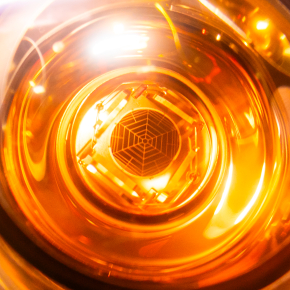
Second prize: 'Vacuum' (public vote)

Also by Yannig Van De Wouwer and taken at GANIL in Caen, this photograph shows a vacuum chamber, an essential piece of equipment for nuclear physics experiments. The play of light and transparency offers a hypnotic view of what is actually a highly technical tool.
Third prize: ‘Eye of a neutrino telescope’ (jury vote)

This photograph, taken by Hugo Pardinilla at the Marseille Particle Physics Centre (CPPM), reveals a fascinating close-up of a photomultiplier from the KM3NeT/ORCA neutrino telescope, installed at a depth of 2,500 metres off the coast of Provence. These ultra-sensitive light sensors, deployed in large numbers, form a giant detector ideal for studying neutrinos, some of the most mysterious elementary particles in the Universe. Through this close-up framing, the image reveals a unique view of the sensor and the technological sophistication of the instrument.
Hugo Pardinilla, 27, is a graphic designer and photographer based in Toulouse. Trained in art direction, he developed his photographic practice through apprenticeship. His long-standing curiosity about science and the living world led him to explore the links between art and scientific research, particularly around biodiversity, the theme of his thesis. His participation in the Global Physics Photowalk gave him the opportunity to surprise himself and put his photographic practice to the test. Faced with the CPPM's equipment, he produced a series of colourful and abstract images, unusual in his work, playing with the shapes, light and textures of scientific instruments.
A competition and a collective adventure
Organised in particle physics laboratories around the world, these visits revealed the aesthetic and human dimension of everyday science. For this first participation, the communications teams at CNRS Nuclear & Particles laboratories designed attractive visitor itineraries and mobilised scientists and staff.
Congratulations to the winners, Yannig Van De Wouwer and Hugo Pardinilla, as well as to all the participating photographers, scientists and host teams who contributed to the success of the 2025 edition of the Global Physics Photowalk.
International jury members
- Dmitri Denisov, deputy associate laboratory director for high energy physics at Brookhaven National Laboratory
- Tabea Rauscher, creative lead at the European Molecular Biology Laboratory at the time of judging, head of communication and marketing at the Max Delbrück Center for Molecular Medicine in the Helmholtz Association as of Jan. 1, 2026
- Will Warasila, freelance photographer for the New York Times,willwarasila.com
Related links
- See all the photos submitted to the competition : Link to the IN2P3 Library
- Read the international press release dated 12 February 2026
International Awardees for Photographs Taken in France
- Yannig Van De Wouwer : Website | LinkedIn | Instagram | Facebook | Photos taken at GANIL
- Hugo Pardinilla : Behance | LinkedIn | Instagram | Photos taken at CPPM
Photographes distingués lors des sélections locales
- Lyon (CC-IN2P3)
Candice Tordjmann (photos at CC-IN2P3 - Facebook - Instagram ) and Pierre-Alexandre Deltrieux, aka Delpial (photos at CC-IN2P3 - Facebook - LinkedIn )
- Marseille (CPPM)
Justine Coustrain-Jean (photos at CPPM ), Hugo Pardinilla (see above) and Anne Haguenauer (photos at CPPM - LinkedIn )
- Caen (GANIL)
Céline Lunel-Moreau (photos at GANIL - Facebook - Instagram - LinkedIn ) and Yannig Van De Wouwer (see above)
- Strasbourg (IPHC)
Lali Sakvarelidze-Achard (photos à l'IPHC ), Victor Fleurentdidier (photos at l'IPHC ) and Benoît Dupont (photos at l'IPHC - Facebook - Instagram - LinkedIn )
- Annecy (LAPP)
Bernard Revillet (photos at LAPP ) and Sylvie Chazal (photos at LAPP )
- Grenoble (LPSC)
Mikaël Passereau (photos at LPSC - X - Facebook - Instagram - LinkedIn ), Morgane Coustrain (photos at LPSC - X - Instagram ) and Jean-Claude Allard (photos at LPSC )