
RICOCHET: on the lookout for the neutrino/nucleus interaction
When a low-energy neutrino encounters an atomic nucleus, it “ricochets” off the surface of the nucleus, which recoils over an infinitesimal distance. This exceptionally rare interaction, observed experimentally for the first time in 2017, is the subject of study by RICOCHET, an international collaboration led by CNRS Nucléaire & Particules and hosted at the Institut Laue Langevin in Grenoble. After more than a year of commissioning, which confirmed the optimal performance of its equipment and increased the number of its detectors, RICOCHET has been engaged in a promising scientific phase since July 2025: characterizing the minute interactions between neutrinos generated by a nuclear reactor and the nuclei of its germanium detectors could, when compared with the predictions of the standard model of particle physics, reveal as yet unknown physical phenomena.
It is at the heart of the experimental zone of the Institut Laue Langevin (ILL) reactor building, surrounded by the soundscape and vibrations of the nuclear reactor and neighboring experiments, that the RICOCHET experimental apparatus, a complex and meticulous assembly of fragile parts sensitive to the slightest disturbance, has gradually taken shape over the past few months. Protected from these disturbances and radiation by its lead, copper, and polyethylene shielding, the experiment collected its first data during a commissioning phase that began in February 2024, the conclusions of which were presented in a scientific article published in PRD. The Ricochet teams present a device capable of discerning collisions involving neutrinos with unparalleled precision from intense background noise. “After six years of setting up the experiment with a collaboration of more than 60 scientists in several countries, we are delighted to have been able to move on to the scientific phase in July. We are now hunting for interactions between neutrinos and atomic nuclei,” comments Julien Billard, researcher at IP2I and coordinator of RICOCHET.
But what exactly is this interaction? It involves studying “coherent elastic neutrino-nucleus scattering” (CeνNS), a very special phenomenon whereby a neutrino “bounces” off an atomic nucleus. At sufficiently low neutrino energies, the neutrino does not interact with individual nucleons but with the nucleus as a whole. The interaction, mediated by a Z boson, causes a tiny recoil of the nucleus, which results in heating of the crystal. Although theorized as early as 1974, scientists long believed that the energy released by this interaction would be too weak to ever be observed. That is why the first detection of CEνNS in 2017 by the COHERENT experiment, which used higher-energy neutrinos from a spallation source, represented a minor revolution.
And for good reason: studying CEνNS in detail is an effective way to test the Standard Model of particle physics, the theoretical paradigm explaining all interactions in the quantum world. The parameters of the CEνNS, such as the Z boson exchange, have the advantage of being relatively simple and predicted with great precision by the Standard Model. The slightest deviation measured experimentally from theoretical predictions could thus reveal previously hidden phenomena, such as new particles, which could shed light on the gray areas of current physics.
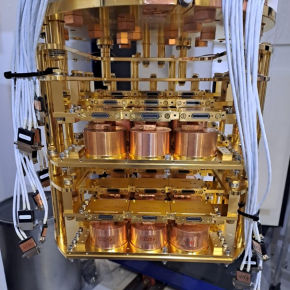
To measure the heating of the order of a millionth of a kelvin caused by the CEνNS, the RICOCHET teams have developed a clever experimental protocol based on very light detectors made of germanium crystals immersed in cryogenic temperatures. At these temperatures of a few millikelvins, the slightest shock—such as the rebound of a neutrino—is detectable by the array of electrodes and sensors that equip the germanium crystal. A total of 18 detectors, each weighing 40 grams, are assembled in a “CryoCube” cooled to 10 mK, which is close to absolute zero, the temperature at which atomic nuclei are completely frozen. To achieve such low temperatures, the collaboration opted for a cryogenic system in which helium-3 is diluted in helium-4 inside a column above the CryoCube. Copper columns transmit the cold from the cryogenic system to the detectors through a thick internal shield. Fine adjustments were necessary to ensure that the wiring to the detection electronics and the thermal load from the stack of detectors did not disturb this fragile balance.
The cooled germanium crystals are ready to receive neutrinos. But without a dedicated neutrino source, they could be waiting a long time: although tens of billions of neutrinos from space pass through every square centimeter of our Earth every second, the overwhelming majority of them do not interact with matter and simply pass through the germanium detectors. To increase the probability of interactions, the experimental device has been placed just a few meters from the ILL's nuclear research reactor. The flood of neutrinos generated by this 58 MW research reactor makes it possible to achieve the expected number of 8 CEνNS events per day.
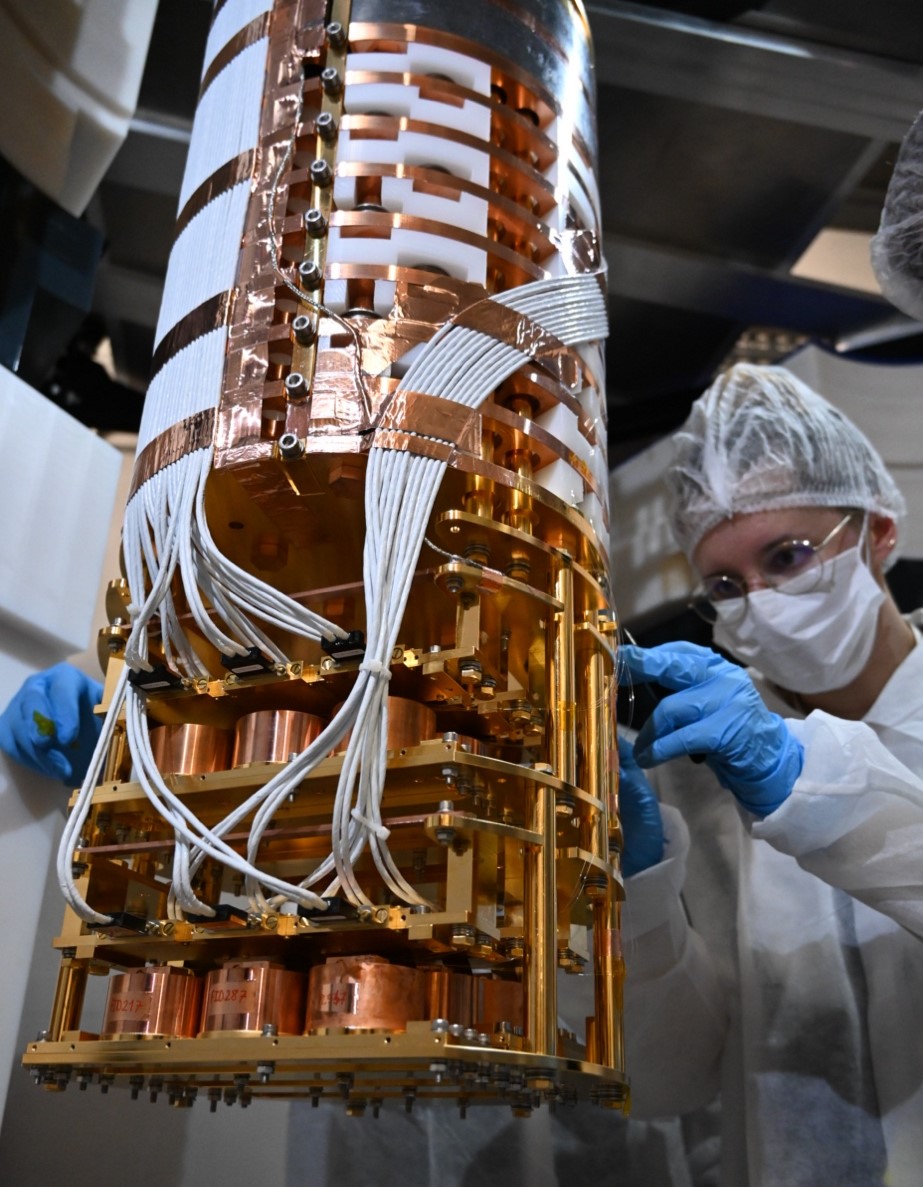
Once the issues of the detection principle and the neutrino source had been resolved, a major problem remained: that of background noise, consisting of numerous interactions of stray particles in the detector, which could be confused with CEνNS events. The RICOCHET collaboration took a number of approaches to combat this problem. First, the experimental device was encased in heavy external shielding consisting of 19 tons of lead and polyethylene, to which was added internal shielding of the same type weighing 150 kg, enabling most of the particles to be filtered out. The external shielding is also equipped with a muon veto, a detector capable of identifying these particles as they pass through all the shielding, in order to locate and eliminate the spurious events they cause in the detector.
But RICOCHET's most effective anti-background weapon, which sets it apart from competing experiments, is its dual ability to measure both heat and ionization (the production of electrons and holes) generated by interactions in the detector. This allows interactions whose heat/ionization ratio does not precisely match that expected for collisions involving neutrinos to be rejected from the experiment's databases, something that cannot be achieved by measuring heat or ionization alone. Background noise elimination has benefited from the introduction of Fully Inter-Digitized (FID) electrodes in 11 of RICOCHET's 18 detectors. These new-generation interdigitated electrodes make it possible to measure ionization while rejecting events close to the surface of the detectors, generally associated with stray particles, where conventional planar electrodes fail to make this distinction.
Finally, it should be noted that the fight against background noise also benefits from the fact that the research reactor operates ON and OFF cycles of fairly similar durations, allowing the team to subtract background noise in order to improve neutrino signal identification.
As can be understood, the device is extremely sophisticated, and it took the team nearly a year and a half to implement and adjust it to make it fully operational. It was necessary to test the cryogenics, the first three detectors, without shielding, then with shielding, and then gradually add new detectors to the CryoCube until reaching a total of 18. The lessons learned during this critical period for the RICOCHET collaboration, compiled in the scientific publication in PRD, are a source of great satisfaction for Julien Billard, who in 2018 was awarded the ERC Starting Grant that funded the CryoCube: "At the end of commissioning, all indicators were green and the data collected was very clean. This gives us the confidence we need to tackle the first scientific phase, which we launched in July. We are excited about the data currently being acquired, which should give us our first scientific results in 2026."
This first scientific phase, funded by an ANR grant obtained in 2020, will last two years, until the summer of 2027, allowing for an initial characterization of the CEνNS parameters. The experiment and its scientific results could then be improved during a second phase, proposed by the collaboration, which would see the addition of detectors in materials other than germanium, for increased performance and reduced measurement uncertainties.