
Groundbreaking Ceremony Marks the Beginning of CTAO-South Array Construction in Chile
Representatives from the Cherenkov Telescope Array Observatory (CTAO), the European Southern Observatory (ESO), and governmental authorities gathered today to celebrate the official groundbreaking of the CTAO’s southern site, CTAO-South. After years of successful site preparations, the event marked the beginning of construction on the telescope foundations, paving the way for the first telescopes to be completed by the end of 2026. The CTAO will be the world’s largest and most powerful observatory for gamma-ray astronomy, and the first to be built in the Southern Hemisphere. With it, Chile will open a new observational window, exploring the Universe at the highest energies.
The ceremony began at ESO’s Paranal Observatory with opening remarks from Thomas Klein, ESO Director of La Silla Paranal Observatory, followed by speeches made by Stuart McMuldroch, CTAO Director General; Xavier Barcons, ESO Director General; Francisco Colomer, Chair of the CTAO ERIC Council, as well as political authorities, including Ricardo Díaz, Governor of the Antofagasta Region; Valeska Molina, Regional Secretary of the Ministry of Science, Technology and Innovation for Antofagasta Region; and Alejandra Pizarro, Director of the National Agency for Research and Development (ANID). The event also brought together international partners from the Chilean scientific community and industry, along with CTAO and ESO staff that joined the celebration of this major milestone in the project’s development.
During his remarks, McMuldroch expressed his excitement for this moment, a culmination of years of dedication and international collaboration. “Thanks to the commitment of our partners from around the world and the support of ESO as our hosts here in Chile, we are now turning a vision into reality as construction begins on what will be the most advanced gamma-ray observatory on Earth.”
“We are happy to welcome this innovative facility to ESO’s family. It’s our pleasure to see the start of construction of the southern site of this powerful observatory here at Paranal in Chile’s Atacama Desert — a place with the most pristine skies on Earth. This groundbreaking is a huge milestone for both CTAO and ESO, but also for Chile as this new facility will strengthen the country’s position as a global hub for astronomy,” said Barcons in his speech.
Following the ceremony, participants moved to the CTAO-South site, located 10 kilometres southeast of Paranal in the Atacama Desert, for a symbolic onsite celebration. There, Volker Heinz, CTAO Construction Programme Manager, welcomed the attendees to the site and then representatives buried a time capsule containing items from Chile and partner countries around the world, symbolising how the work undertaken in Chile will contribute to scientific progress on a global scale. The capsule also included scientific items representing the ultimate goal of the telescopes now under construction: to advance our understanding of the Universe and expand human knowledge. A commemorative plaque, set upon nearby stones, now marks the location of the buried capsule, beside the future telescope area.
The CTAO, ESO, and Chile signed agreements to have the CTAO southern array hosted at ESO's Paranal Observatory in 2018. “Paranal is a unique place in the world to study the Universe,” highlighted Heinz during his welcoming speech at CTAO-South, explaining that Paranal is already home to ESO’s VLT — a key instrument in the discoveries recognised by the 2020 Nobel Prize in Physics — and the ESO’s Extremely Large Telescope that can be seen under construction in the distance from CTAO-South. "The Atacama Desert now welcomes another world-leading facility, and, in just one year, we expect to have here CTAO telescopes providing the first-ever observations of the gamma-ray sky from Chile.”
To cover its broad energy range — from 20 GeV to 300 TeV, billions of times more energetic than visible light — the CTAO will employ three types of telescopes: the Large-Sized Telescopes (LSTs), the Medium-Sized Telescopes (MSTs), and the Small-Sized Telescopes (SSTs). The current configuration for CTAO-South includes more than 50 telescopes. To give the CTAO a complete view of the night sky, it will have two arrays of telescopes located in both the northern and southern hemispheres. The CTAO-South site in Chile, in tandem with the CTAO-North site in La Palma, Spain, will revolutionize our view of the high-energy Universe.
With its unprecedented sensitivity and precision, the CTAO will help address some of the most fundamental questions in astrophysics. Its research will focus on three key areas: understanding the origin and role of relativistic cosmic particles; probing extreme environments such as black holes and neutron stars; and exploring the frontiers of physics by searching for dark matter and testing the limits of Einstein’s theory of relativity. In addition, the CTAO will play a key role in multi-wavelength and multi-messenger astronomy in the coming decades, providing essential gamma-ray data to complement observations across the entire electromagnetic spectrum and from other cosmic messengers such as neutrinos and gravitational waves.
The CTAO is also a Big Data project, expected to generate hundreds of petabytes of data each year (around 12 PB after compression). Committed to the principles of Open Science, it will be the first gamma-ray observatory to operate as an open, proposal-driven facility, providing public access to its high-level scientific data and software products. Ten per cent of the observing time at CTAO-South is reserved for Chilean scientists, guaranteeing that Chile, as host country, gains direct scientific returns and strengthens its own research capacities through the Observatory’s presence.
As construction begins in the Atacama Desert, today’s ceremony symbolises not only a technological milestone but also a shared commitment from Chile and the international community to push the boundaries of what we know about the most energetic and mysterious corners of the Cosmos.
The French contribution to CTAO
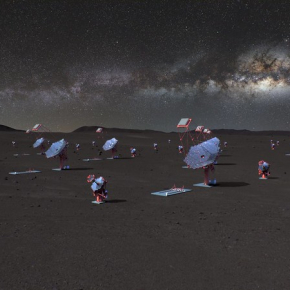
The French scientific and technical staff involved in CTAO come from CNRS laboratories (CNRS Nuclei & Particles and CNRS Earth & Universe) and IRFU at CEA Paris-Saclay. They contribute to many aspects of the infrastructure's implementation and scientific operation. A significant part of the contribution concerns the three types of telescopes (pictured, from left to right, SST, MST, and LST), dozens of which will equip the Observatory's two networks, detecting Cherenkov light produced by the interaction of gamma rays in the atmosphere, between 10 GeV and 100 TeV. More specifically, the French contribution involves: for the LSTs, the design of the arches, the camera controllers, and the motorization of the mechanical structure; for the MSTs, the design, construction, and integration of fast electronics cameras (NectarCAM) and the design and supply of mirrors; for the SSTs, the design and integration of the telescopes. The French teams are also contributing to monitoring atmospheric quality by building a LIDAR on the South site. Finally, they are playing a leading role in deploying the data analysis chain for the telescope networks and scientific analysis tools for the celestial vault for future users of the Observatory.
12 CNRS laboratories involved
CNRS Nuclei & Particles: the Astroparticle and Cosmology Laboratory (APC, Paris), the Marseille Particle Physics Center (CPPM, Marseille), the Irène Joliot Curie Laboratory of Physics of the Two Infinities (IJCLab, Orsay), the Annecy Laboratory of Particle Physics (LAPP, Annecy), the Leprince Ringuet Laboratory (LLR, Palaiseau), the Bordeaux Laboratory of the Two Infinities (LP2I Bordeaux), the Laboratory of Nuclear Physics and High Energies (LPNHE, Paris), the Montpellier Laboratory of Particles and the Universe (LUPM, Montpellier).
CNRS - Earth & Universe: the Grenoble Institute of Planetology and Astrophysics (IPAG, Grenoble), the Institute for Research in Astrophysics and Planetology (IRAP, Toulouse), the Universe and Theories Laboratory (LUTH, Meudon), and the Côte d'Azur Observatory (OCA, Nice).